
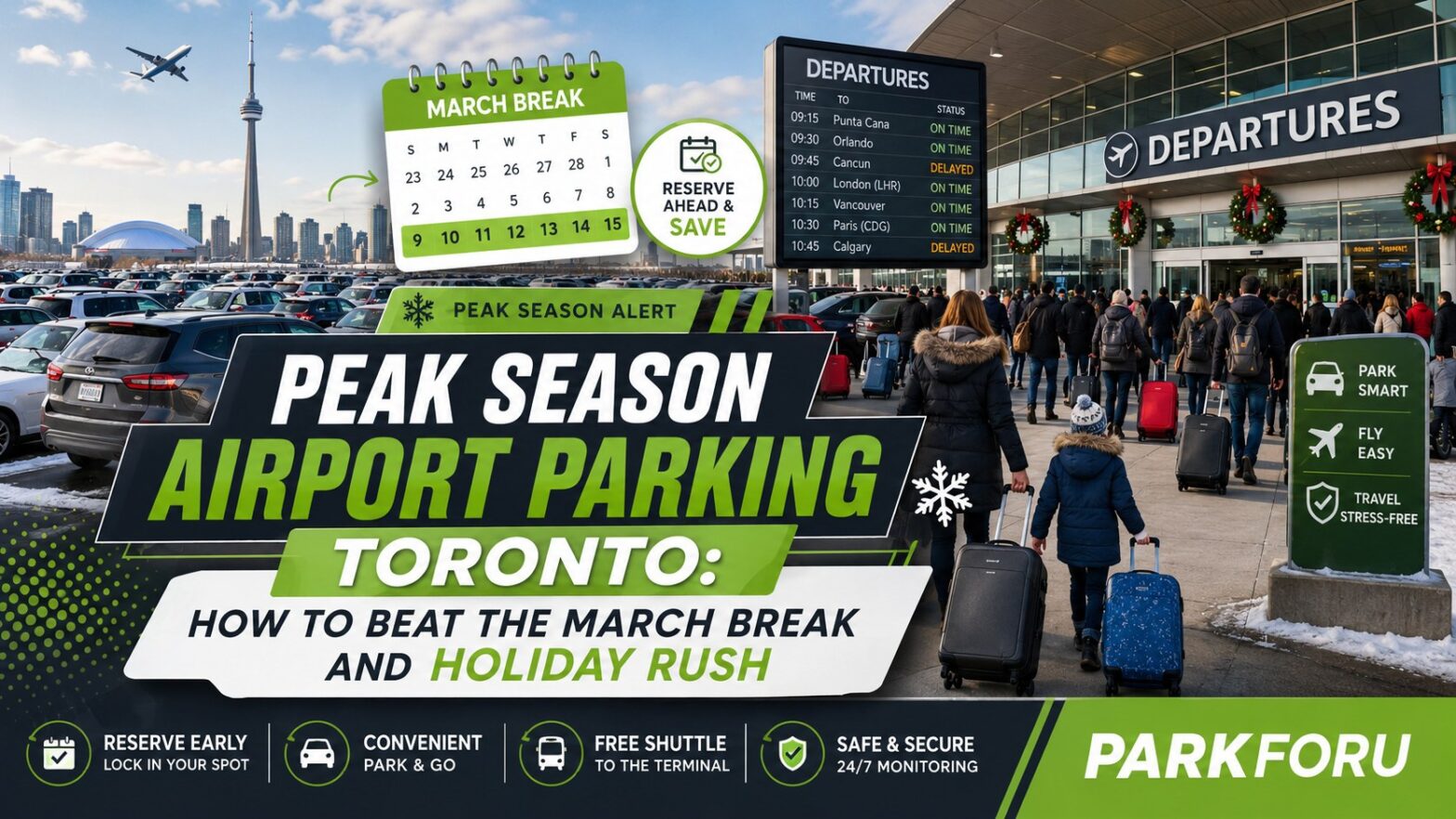
Peak season airport parking Toronto travellers need in March or late December is not the same product they book in October. It is scarcer, it is pricier, and it sells out. The lot that had space on a Tuesday morning in autumn has a queue at the barrier on the Friday before March Break.
The good news is that peak periods at Pearson are entirely predictable. Here is what the numbers actually say, and how to work around them.
Quick answer: peak season airport parking Toronto demand spikes hardest during March Break and the December holidays, when Pearson handles millions of extra travellers but parking capacity stays fixed. Book four to six weeks ahead, travel midweek where possible, and choose a guaranteed space over the cheapest unconfirmed lot.
Toronto Pearson is Canada’s largest airport by a wide margin. The GTAA reported 47.3 million passengers through Pearson in 2025, split between roughly 17.2 million domestic and 30.1 million international travellers.
Those passengers do not arrive evenly.
March Break. In 2026 the airport expected around 1.7 million travellers across the March Break window, roughly 400,000 more than the previous year. Peak days reached as many as 163,774 travellers moving through the airport in 24 hours. The break period ran from about 12 March to 22 March.
The December holidays. Pearson has handled around 3.2 million travellers across a single holiday season — the densest sustained period on the calendar.
Summer. Late June through August produces the longest average stays, which matters for parking specifically. More people are gone for two weeks rather than two days, so lots fill and stay full.
Within each period, the pattern repeats. The first weekend and the final two or three days are the crush. Midweek is noticeably calmer. Toronto Pearson’s March Break guidance confirms the same shape.
Airlines add capacity for peak periods. Parking lots cannot. The concrete does not expand for March Break.
That mismatch produces three predictable effects. First, the cheapest inventory disappears earliest, because it is the first thing people book. Second, walk-up rates climb, since the remaining spaces are the expensive ones. Third, the queue at the barrier grows, so the ten minutes you allowed for parking becomes thirty.
None of this is a surprise to the airport. It is a surprise to travellers, every single year.
Worth noting too: peak season airport parking Toronto pricing rarely spikes dramatically the way flights do. What changes is availability. The lots do not triple their rates overnight — they simply run out, and you are left choosing between whatever is still open and whatever is closest. That is why booking early saves more than hunting for a discount does.
Reserve four to six weeks ahead for a major peak. For March Break and Christmas, this is the single highest-value thing you can do. For an ordinary week, a few days is fine.
Book the moment you book flights. Treat parking as part of the itinerary rather than an afterthought. It costs nothing to hold the reservation, and the price only moves in one direction.
Fly midweek if you have any flexibility. A Wednesday departure during March Break is a meaningfully different experience from a Saturday one, at the terminal and in the lot.
Choose a service with a guaranteed space, not a first-come lot. In peak season a confirmed reservation is worth more than a small discount. Arriving to a full lot with a flight in two hours is the definition of a bad morning.
Check for codes before you pay. Our current ParkForU coupon codes post is updated with live offers, and if you have left it late, last-minute parking deals covers what is still possible inside 48 hours.
Pearson advises arriving roughly three hours before an international departure and two hours before a domestic one. During peak weeks, treat that as a floor rather than a target.
Build your morning backwards. Work out your security time from CATSA security wait times, add the airline’s check-in cutoff, then add 30 to 40 minutes for parking, transfer and the walk in. On a March Break Saturday, that easily becomes a four-hour lead from your front door.
Two other details matter more than people expect. Drop-off curbs get gridlocked during peaks, so a kerbside handover can take longer than parking properly. And the LINK train from Value Park, which is quick in September, carries a queue in March.
The core problem in peak season is variability. You cannot predict how long it will take to find a space in a full garage, and that uncertainty is what makes people panic.
Valet removes the variable. You drive to the lot, a member of staff meets you, your luggage comes out, the keys change hands, and you go. The time is fixed rather than a lottery. On the return leg it works the same way — you message your landing time and the car comes to you rather than you hunting for it through a packed structure at midnight.
That is worth the most precisely when the airport is busiest. We covered the mechanics in our travel rush season guide, and if you are travelling with children, family valet parking with kids is worth five minutes of your time before March.
Peak season airport parking Toronto travellers rely on is a supply problem, not a price problem. The spaces exist, but there are fewer of them than there are people who want them, and the cheapest ones go first. Book early, travel midweek if you can, and pick a service that guarantees your space rather than hoping for one.
March Break or Christmas coming up? Reserve valet parking in Toronto now, while the rate is still the low one.
The two heaviest periods are March Break and the December holidays. Pearson expected around 1.7 million travellers across the 2026 March Break window, with peak days approaching 164,000 people, and has handled roughly 3.2 million across a single holiday season. Summer produces the longest average parking stays.
Four to six weeks is a sensible target for March Break and Christmas. The cheapest spaces sell first, and walk-up rates during peak weeks are consistently higher than reserved ones.
Start from the airport’s guidance of about three hours for international and two for domestic, then add 30 to 40 minutes for parking, transfer and walking. On the busiest days of March Break, a four-hour lead from home is realistic.
Yes. Parking capacity is fixed while passenger volumes surge during peak weeks, so the cheapest inventory disappears first and remaining lots reach capacity. A confirmed reservation is the only reliable protection.